Accuscore's NHL Playoffs 2026 Predictions & Bracket
The NHL playoffs 2026 start tonight and the simulations show an extremely interesting and close battle for the Stanley Cup once again!
Colorado’s Dominance Meets Regression Risk
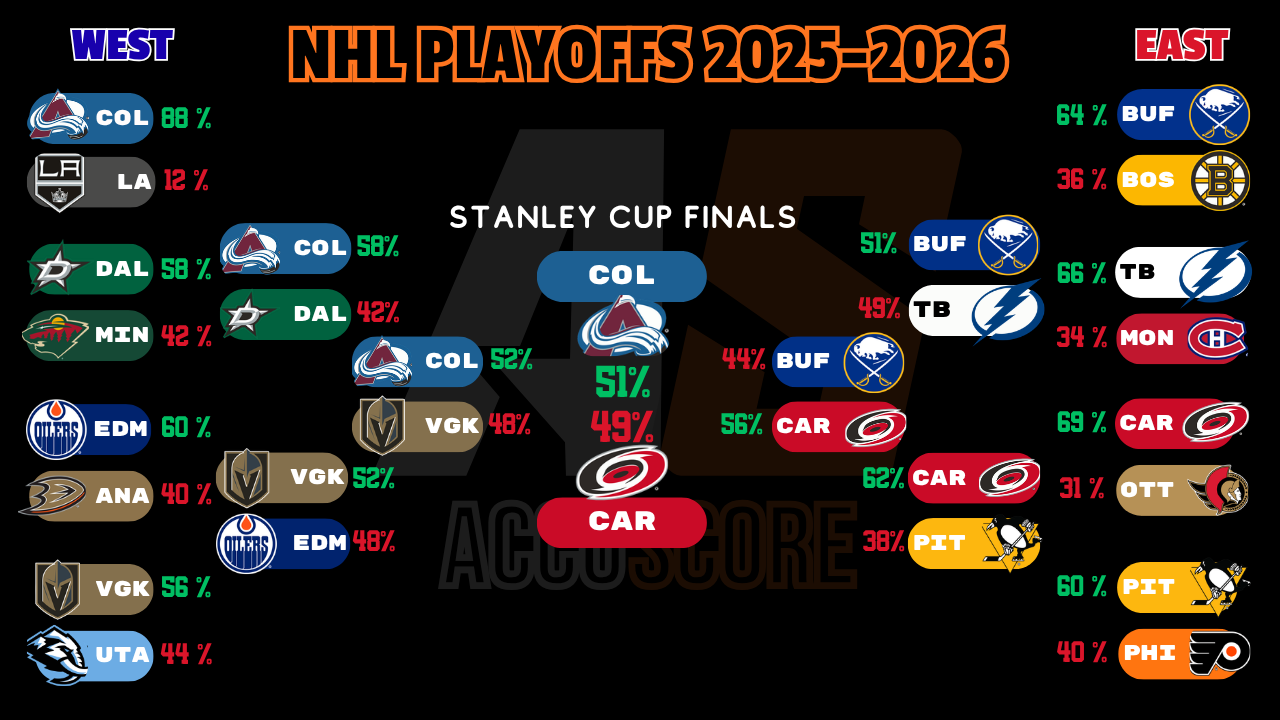
The simulated bracket aligns closely with what underlying data suggests about the NHL hierarchy, particularly in the Western Conference. Colorado’s 51% probability to win the Cup is backed by elite performance indicators, including a 50+ win pace and one of the league’s best goal differentials. Offensively, they operate near the top tier in goals per game while maintaining a strong defensive profile, a combination typically associated with legitimate Stanley Cup contenders. However, advanced metrics such as expected goals (xGF%) indicate that their finishing efficiency may be slightly inflated relative to chance quality. This creates a subtle but important gap between perception and sustainability. In a playoff setting where variance tightens, that edge can shrink quickly. That is exactly why the model stops short of assigning them clear dominance despite strong surface-level numbers.
Carolina’s Analytical Edge in the East
Carolina’s 49% Cup probability and 56% chance to win the East are strongly supported by underlying analytics rather than headline results. They consistently rank among league leaders in puck possession and shot share, often controlling nearly 60% of play at even strength. This type of territorial dominance is one of the most reliable predictors of playoff success. Unlike Colorado, Carolina’s numbers are less dependent on shooting variance and more rooted in repeatable systems. Their offensive generation and defensive structure translate well into postseason hockey, where space and time are limited. Recent playoff runs have also demonstrated their ability to sustain performance under pressure. This analytical stability explains why the simulations treat them as an equal to Colorado despite a potentially lower public perception.
Eastern Conference: Depth Creates Volatility
The Eastern Conference bracket highlights just how little separates contenders beyond the first round. Teams like Tampa Bay (66%) and Buffalo (64%) show strong opening probabilities, but those edges compress rapidly in later rounds. Matchups such as Buffalo vs Tampa Bay, projected at 51% to 49%, underline the lack of separation among elite teams. Carolina’s path is slightly clearer statistically, but even they face multiple near coin-flip scenarios. A significant portion of games involving top Eastern teams have gone beyond regulation, reinforcing how narrow the margins are. This depth-driven volatility makes the East particularly difficult to project with confidence. As a result, probabilities remain tightly clustered rather than top-heavy.
Western Conference: Thin Margins Behind a Favorite
While Colorado appears as the standout in the West, the path is far from straightforward. Vegas, projected at 48% in a potential matchup with Colorado, represents a serious disruption risk. Edmonton’s 60% first-round probability also signals offensive firepower that can swing a series quickly. Even lower-seeded teams like Utah and Minnesota sit close enough in probability to create early-round instability. These layers of competition reduce the likelihood of a clean, dominant run through the conference. The simulations reflect this by keeping Colorado’s advancement probabilities relatively modest in later rounds. In practical terms, the West is structured around a favorite, but not controlled by one.
Betting Perspective: Value Lies in the Margins
From a betting standpoint, the most important takeaway is the compression of probabilities across the board. No team exceeds a 51% chance to win the Stanley Cup, which immediately limits the value of short-priced favorites. Colorado may attract market attention, but their statistical profile suggests limited upside at reduced odds. Carolina, on the other hand, combines strong underlying metrics with slightly less public hype, creating potential value depending on pricing. Teams like Vegas or Tampa Bay, sitting near 48–49% in key matchups, offer classic contrarian opportunities. The structure of the bracket supports a diversified betting strategy rather than a single outright position. In a playoff field defined by parity, exploiting small inefficiencies becomes far more effective than chasing perceived certainty.



